How to Check Blog SEO Score Before Publishing (Step-by-Step Guide)
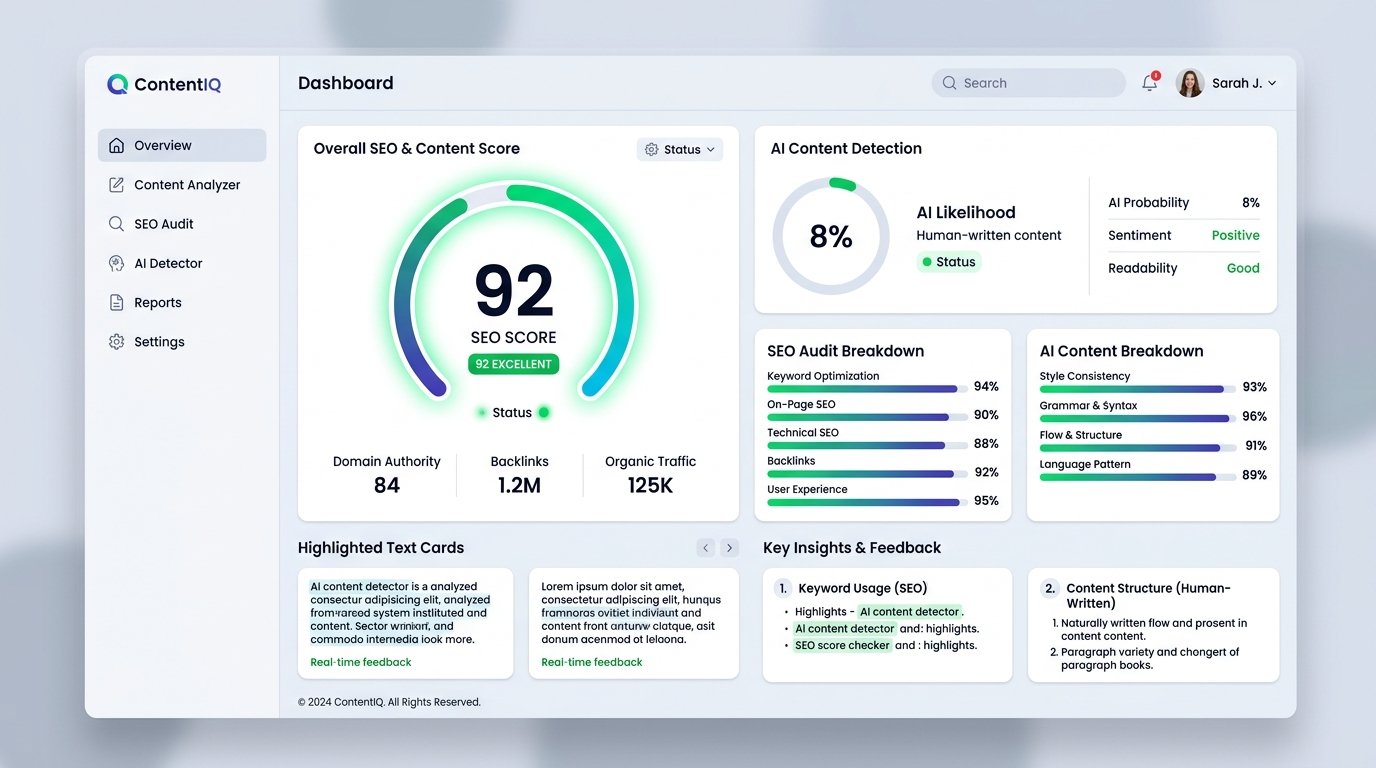
Hitting "Publish" without auditing your blog post's on-page search engine optimization is like launching a rocket without checking its trajectory. You might have poured five hours into researching and drafting your article, but if your headings are misaligned, your keyword distribution is unbalanced, or your sentence rhythm is too dense, search engines will simply overlook your work.
In this guide, we break down the exact, step-by-step protocol experienced digital publishers use to check their blog SEO score before pushing any article live.
What is a Blog SEO Score?
A blog SEO score is a quantitative measurement—typically on a scale of 0 to 100—that reflects how well your written content adheres to search engine ranking factors and human readability standards. Unlike vanity metrics, an authentic SEO score evaluates several interdependent technical and semantic parameters:
- Keyword Optimization: Primary and semantic keyword presence in titles, introductions, headings, and body text without unnatural stuffing.
- Structural Hierarchy: Logical cascading of H1, H2, and H3 subheadings that outline the topic clearly for search crawlers.
- Readability & Cadence: Flesch Reading Ease score, average sentence length, and paragraph brevity.
- Content Depth: Substantive word count and topical entity coverage that completely answers user search intent.
- AI vs. Human Authenticity: Absence of monotonous synthetic patterns that trigger Google's Helpful Content penalties.
Step 1: Check Your Primary Keyword Frequency & Density
Your target keyword should appear in key strategic positions, but never exceed a 1.0% to 2.2% overall density. If a 1,000-word blog post mentions the exact focus keyword 40 times, search engines will flag it for keyword stuffing, leading to an immediate ranking suppression.
Ensure your target keyword appears in:
- The main H1 title (ideally within the first five words).
- The opening 100 words of the introduction.
- At least one or two H2 subheadings.
- Naturally throughout the body text, supplemented by semantically related synonyms (LSI keywords).
Step 2: Validate Your Heading Hierarchy (H1 > H2 > H3)
Search engines treat HTML headings as an article's table of contents. A common mistake among beginner bloggers is choosing heading tags based on visual font size rather than semantic structure. Follow these golden rules:
- Exactly one H1 tag per page representing your main article headline.
- H2 tags for major thematic sections of your guide.
- H3 tags strictly for sub-points nested inside an H2 section. Never skip heading levels (e.g., jumping from H2 directly to H4).
Step 3: Measure Reading Ease with the Flesch Formula
Over 60% of modern blog visitors browse on mobile devices. If your paragraphs contain 40-word run-on sentences with complex jargon, your bounce rate will skyrocket. Google tracks dwell time and engagement signals; if visitors immediately return to search results, your rankings will decline.
Aim for a Flesch Reading Ease score between 60 and 70, which corresponds to plain English understandable by an 8th-grade student. Break paragraphs after 2 to 4 sentences maximum.
Step 4: Use ContentScope for an Instant, Multi-Dimensional Audit
Rather than manually counting words, calculating syllables, and checking tags by hand, you can run your unpublished draft through ContentScope's Free SEO Score Checker. In less than 20 seconds, the tool performs a comprehensive dual analysis:
- Mathematical On-Page Parser: Calculates exact word counts, heading counts, sentence rhythm, and keyword frequency.
- Semantic AI Intelligence (Google Gemini): Inspects text context, flags robotic synthetic transitions, and delivers specific, copy-paste-ready sentence rewrites.
Step 5: Apply Actionable Fix Suggestions Before Publishing
The biggest advantage of ContentScope over traditional SEO plugins is that it doesn't just diagnose issues with generic red lights—it provides Actionable Rewrites. If your introductory hook is weak, the tool generates a revised sample sentence with emotional resonance and clarity that you can directly copy into your WordPress or Google Docs editor.
Summary Checklist Before You Hit Publish
- SEO Health Score: 75+ / 100.
- Human Voice Score: 70%+ authentic.
- Flesch Reading Ease: 60–75.
- Single H1 tag with descriptive H2 and H3 subheadings.
- Compelling meta description between 150 and 160 characters.
Test your draft now on ContentScope and publish with complete confidence!
Ready to check your own content?
Get a free AI-powered SEO analysis with actionable fix suggestions.
Try the Free SEO Checker